How to Prevent Revenue Leaks in Your Growing B2B Company

Steven Janiak
Founder & AI Systems Architect
Updated February 23, 2026
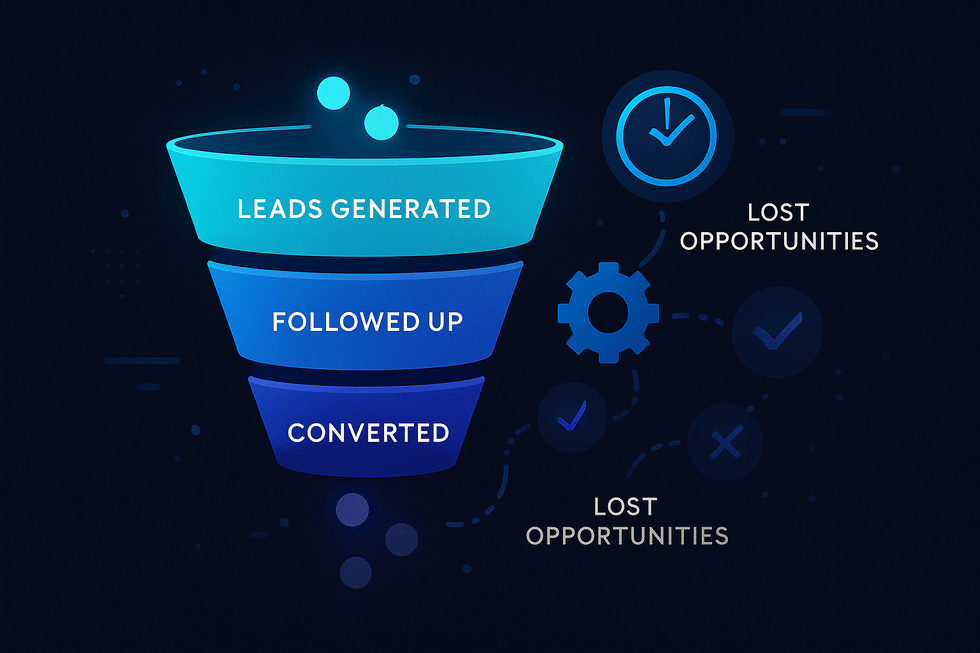
You generated 150 leads last month. Only 20 closed. The rest? Lost in follow-up chaos, missed calls, and forgotten emails. This isn’t just operational clutter; it’s revenue leakage with a financial impact. For growing B2B companies, addressing this inconsistency is crucial. Let’s explore how structured automation can plug these revenue holes efficiently.
Key Takeaway
"Revenue inconsistency is rarely a lead problem; it's a system problem. Successful companies don’t work harder—they automate smarter, eliminating friction and capturing lost opportunities."
The Real Cost of Revenue Leakage
Revenue leakage can silently drain your business’s potential, converting what should be a robust revenue stream into a trickle. Suppose you’re losing just $1,000 per month per employee due to inefficiencies in follow-up or missed opportunities. In a 20-person firm, that’s $240,000 annually. Imagine redirecting this into growth.
Here’s how revenue leakage adds up:
- Lost lead conversion: $1,000/month per employee
- Missed sales opportunities: $500/month per employee
- Inefficient CRM use: $300/month per employee
Unchecked, these leaks could cost up to 10% of your annual revenue. With automation, these losses can be minimized, if not eliminated.
Why Hiring Isn’t Solving It
When faced with revenue leakage, many companies default to hiring. But more hands don’t fix broken systems. Hiring adds costs and management overhead without addressing core issues.
Consider this:
- Cost: Salaries and benefits increase overhead.
- Delay: Hiring and training takes time.
- Management Overhead: More employees mean more complexity.
Automation, on the other hand, amplifies existing resources without ongoing cost increases. It’s not about more people; it’s about smarter systems.
What Revenue Automation Actually Means
Revenue automation isn’t about robots replacing people. It’s about systems that ensure consistent follow-up, streamline CRM processes, and ensure no opportunity is missed.
Here’s what it involves:
- Automated follow-up sequences
- Lead scoring and nurturing
- CRM integration and orchestration
These systems ensure every lead is touched, every opportunity is maximized, and every process is optimized.
How Much Revenue Automation Costs (Real Numbers)
Implementing revenue automation can be a cost-effective strategy. Most structured systems can be set up for $5,000–$15,000, a one-time investment to eliminate ongoing losses.
Most implementations are completed within 14 days, with immediate improvements in follow-up consistency and lead capture.
What Happens in the First 30 Days
Wondering what the first month looks like? Here’s a breakdown:
- Discovery: Mapping current processes and identifying leaks.
- Design: Creating tailored automation workflows.
- Deployment: Implementing systems with minimal disruption.
- Testing: Fine-tuning workflows for maximum efficiency.
- Training: Ensuring teams understand and utilize new systems.
These steps ensure a seamless transition to automated systems, enhancing revenue capture.
Is This Right for a Company Like Yours?
Deciding whether to automate can be daunting. Here are common concerns and why automation might be right for you:
- Is this overkill? No, it’s about efficiency, not size.
- Can’t we just hire? Hiring doesn’t fix systemic issues.
- Will this be complicated? Systems are designed to simplify.
- Are we too small? Even small leaks can sink a ship.
Automation is about building a resilient, scalable growth engine. It’s not just for the big players; it’s for any company looking to grow smartly.
For a deeper dive into pitfalls to avoid, check out automation pitfalls.
Explore our operational automation solutions to see how these systems can transform your revenue consistency.
Want to see exactly where revenue is leaking in your system? Schedule a free 30-minute Revenue Audit. We’ll map your pipeline, identify friction points, and show you what structured automation would look like for your company. No pitch. Just clarity.

Steven Janiak
Founder & AI Systems Architect
Steven Janiak is the founder of Sailient Solutions, an AI and business infrastructure consultancy based in Charleston, South Carolina. He specializes in AI-driven revenue systems, CRM automation, and operational architecture for growth-stage service businesses. With over a decade of experience building high-performance web and MarTech systems, Steven focuses on practical AI implementations that drive measurable ROI.
See How This Applies to Your Business
You just read the concept. Now see what it would look like inside your business and what systems would actually make sense.
Guide delivered instantly via email