AI.com Crashed During the Super Bowl. Here’s the Real Lesson for Businesses Betting on AI

Steven Janiak
Founder & AI Systems Architect
Updated February 23, 2026
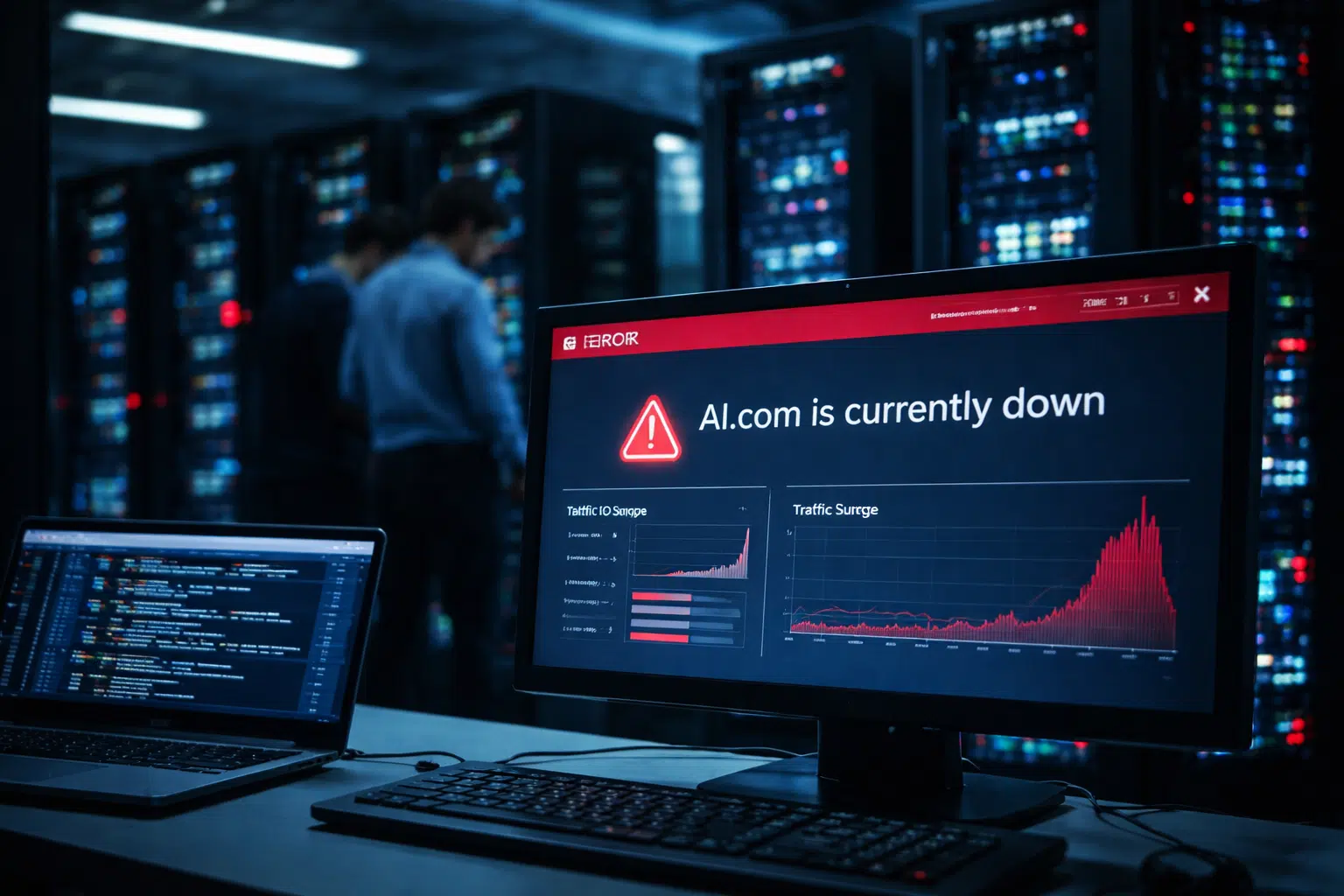
During the Super Bowl, traffic surged to AI.com and the site struggled to stay online. It was a predictable stress test that revealed how unprepared many AI systems are for real-world demand
Key Takeaway
"AI demand spikes instantly, not gradually. The AI.com outage shows that deploying AI without scalable infrastructure risks downtime, trust, and revenue when attention peaks."
During the Super Bowl, millions of people turned to AI.com at the same time.
And the site couldn’t handle it.
Whether you were checking during a commercial, following social chatter, or watching the spike unfold live, the outcome was the same: traffic surged, systems strained, and availability dropped.
This wasn’t just a website hiccup.
It was a live, high-stakes stress test of what happens when AI demand outpaces operational readiness.
And it exposed a hard truth many companies are about to learn the expensive way.
What Happened During the Super Bowl Traffic Surge
The Super Bowl is one of the largest predictable traffic events on the planet.
When a brand, platform, or domain is mentioned during that moment, traffic doesn’t grow gradually. It spikes instantly.
In this case:
- Massive simultaneous requests
- Global traffic concentration
- Zero tolerance for downtime
- No second chances
This wasn’t an unpredictable edge case.
This was a known event colliding with infrastructure that wasn’t designed for real-world scale.
Why This Matters Far Beyond AI.com
It’s easy to point at a single domain and move on.
But this failure highlights a much larger issue we see every week when working with growing businesses.
Many companies are:
- Experimenting with AI tools
- Running pilots
- Adding chatbots
- Connecting models to live workflows
- Exposing AI systems to customers
Without addressing the operational foundation underneath.
When demand spikes, systems break.
Not because AI doesn’t work
But because the systems supporting it were never built to scale
The Real Failure Wasn’t AI. It Was Architecture.
AI didn’t fail during the Super Bowl.
Operations did.
Specifically:
- Load handling
- Traffic routing
- Infrastructure elasticity
- Dependency management
- Failure isolation
- Monitoring and fallback planning
This is the difference between:
- “We added AI”
- And “We built AI systems”
Most companies are still stuck in the first category.
The Warning for Businesses Investing in AI Right Now
If your business:
- Has an AI chatbot on your site
- Uses AI in customer-facing workflows
- Plans to promote AI heavily
- Is preparing a big launch, PR moment, or ad push
You should assume traffic spikes will happen.
And you should ask yourself one uncomfortable question:
What breaks first when demand surges?
Because something always does.
How to Avoid Becoming the Next Cautionary Example
High-visibility moments don’t reward speed alone.
They reward preparation.
That means:
- Designing AI systems with real traffic in mind
- Stress-testing workflows before launch
- Understanding dependencies across vendors, APIs, and platforms
- Planning for failure instead of hoping it won’t happen
This isn’t about perfection.
It’s about resilience.
Why This Is an Opportunity for Smart Operators
Moments like this create two types of companies:
- Those who react after things break
- Those who quietly fix the problem before anyone notices
The second group doesn’t chase tools.
They design systems.
And that gap is widening fast.
What We’re Seeing Behind the Scenes
At Sailient Solutions, we work with teams that are already asking:
- How do we scale AI beyond pilots?
- How do we protect revenue when AI demand spikes?
- How do we avoid outages, downtime, and customer trust loss?
- How do we make AI reliable, not just impressive?
Those are the companies that will win the next 12–24 months.
Final Thought
The Super Bowl didn’t break AI.
It revealed who’s actually ready for it.
If a single traffic surge can expose operational cracks at the highest level, imagine what’s lurking inside most businesses right now.
The question isn’t whether AI demand will spike again.
It’s whether your systems are ready when it does.
How Sailient Solutions Can Help
If you’re actively using or planning to deploy AI in your business, now is the moment to pressure-test your systems.
We help operators identify where AI workflows fail under real-world conditions, before customers ever see it.

Steven Janiak
Founder & AI Systems Architect
Steven Janiak is the founder of Sailient Solutions, an AI and business infrastructure consultancy based in Charleston, South Carolina. He specializes in AI-driven revenue systems, CRM automation, and operational architecture for growth-stage service businesses. With over a decade of experience building high-performance web and MarTech systems, Steven focuses on practical AI implementations that drive measurable ROI.


See How This Applies to Your Business
You just read the concept. Now see what it would look like inside your business and what systems would actually make sense.
Guide delivered instantly via email